How to Maintain Legacy Software Without Putting Your Business at Risk
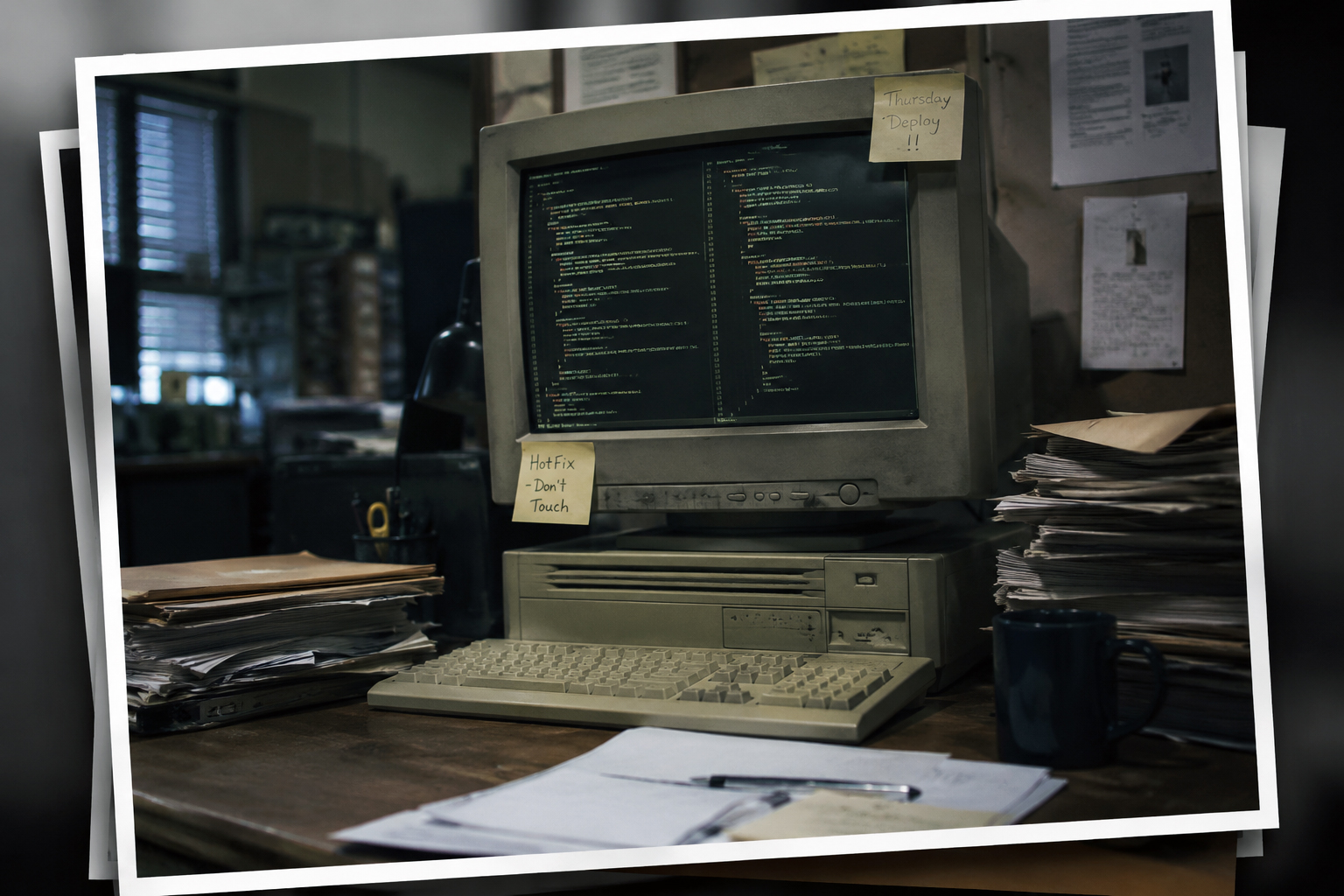
There is a moment that repeats itself in almost every serious legacy software project.
A phone rings. An email arrives. On the other side is not a startup looking for a new application or a company searching for a modern redesign. More often, it is a business owner, director, or IT manager trying to explain a problem that has been growing quietly for months, sometimes years.
The system still works.
The business still depends on it.
But nobody is completely sure how it works anymore.
The original developer is gone. Documentation is missing or outdated. Every modification feels risky. New features keep getting postponed because nobody wants to take responsibility for changing something they do not fully understand. At some point, the software stops being a tool and starts becoming a liability.
That is when a system becomes legacy software.
One of the biggest misconceptions in the industry is that legacy software simply means old software. That is not true. Over the years, I have seen applications that were fifteen or twenty years old and still remarkably maintainable. They were well documented, properly structured, and continuously improved. At the same time, I have encountered projects that were only a few years old where nobody could confidently explain what would happen if a single function was modified.
Age is rarely the problem.
The loss of knowledge is.
A legacy system emerges when a business becomes dependent on software that nobody fully understands anymore.
This is why legacy software maintenance has far less to do with programming languages, frameworks, or databases than most people think. Those technologies certainly matter, but they are rarely the biggest challenge. The real challenge is the business logic that has accumulated inside the system over many years.
Every company develops its own way of doing things. Special pricing rules. Approval workflows. Customer-specific exceptions. Integrations with partners. Automated processes that have been running for so long that nobody talks about them anymore.
The problem is that much of this knowledge never makes it into documentation.
It exists only inside the application.
When the people who built the system leave, a significant portion of that knowledge leaves with them.
This is where many organizations make a costly mistake. They assume the solution is to rebuild everything from scratch. On the surface, that sounds reasonable. If the current software is difficult to maintain, why not replace it entirely?
In practice, things are rarely that simple.
Some of the most expensive software projects begin with a phrase that sounds perfectly logical:
“Let’s rebuild it.”
A new system promises modern technology, cleaner architecture, and a fresh start. What often gets overlooked is that the existing system contains years of business decisions that were never formally documented. Once redevelopment begins, teams quickly discover dozens or even hundreds of processes they never knew existed.
Suddenly, what seemed like a software project becomes a business archaeology project.
That is why successful modernization rarely starts with writing new code.
It starts with understanding the old code.
Before you change a system, you need to understand it.
Before you modernize it, you need to know what it actually does.
Before you replace it, you need to know what cannot be lost.
Organizations that handle legacy software successfully understand this principle. They invest time in technical analysis, business logic discovery, dependency mapping, and documentation before making major architectural decisions.
Unfortunately, many businesses only start thinking about these things when something breaks.
A hosting provider drops support for an outdated environment.
A third-party API changes its requirements.
A security vulnerability requires immediate action.
A database issue starts affecting operations.
A server migration reveals years of hidden technical debt.
Suddenly there is no time for planning.
Everything becomes urgent.
And urgent projects are almost always more expensive than preventive maintenance.
One of the most damaging assumptions a company can make is treating software maintenance as a cost rather than an investment. Nobody questions the need to maintain a building, replace aging electrical systems, or service critical machinery. Businesses understand that waiting for failure is usually more expensive than preventing it.
Software is no different.
Effective legacy software maintenance goes far beyond installing updates. It involves continuously documenting critical knowledge, reducing technical debt, improving security, monitoring infrastructure, reviewing integrations, and identifying risks before they become emergencies.
Perhaps most importantly, it involves reducing dependence on individual people.
If only one person understands a critical system, that is not a technical issue.
It is a business risk.
Many organizations believe they own their software because they possess the source code. In reality, owning source code and owning knowledge are not the same thing. If nobody understands the logic behind the code, the organization does not truly control the system it depends on.
This is one reason documentation remains one of the most valuable investments a company can make. Good documentation is not about producing hundreds of pages that nobody reads. It is about preserving critical knowledge. Architecture decisions. Business rules. Integration details. Deployment procedures. The information that allows future teams to understand how the system works and why it works that way.
Infrastructure deserves equal attention.
Legacy software is not just an application. It is a complete ecosystem that includes servers, databases, operating systems, backups, networking, monitoring, security controls, and automation processes. An application may continue functioning for years, but if the environment around it becomes outdated, problems will eventually appear regardless of how well the code was written.
That is why legacy software maintenance requires a broader perspective. You are not maintaining a piece of software. You are maintaining an entire business system.
The organizations that manage legacy software successfully do not wait for disaster before taking action. They continuously improve their understanding of existing systems. They document critical knowledge. They reduce technical debt gradually. They modernize where necessary without disrupting operations. Most importantly, they recognize that software maintenance is ultimately about protecting business continuity.
Because legacy software is not really a technology problem.
It is a business continuity problem.
Revenue depends on software.
Operations depend on software.
Customer relationships depend on software.
Decision-making depends on software.
The longer critical knowledge remains trapped inside aging systems, the greater the risk becomes.
The biggest mistake an organization can make is assuming that software which works today will continue working indefinitely without attention.
Software rarely collapses overnight.
Knowledge disappears first.
And once knowledge is gone, problems tend to arrive much faster than anyone expects.
Final Thoughts
Every software system eventually becomes a legacy system. The question is not whether it will happen, but whether the organization will be prepared when it does. Businesses that invest in understanding their software, documenting critical knowledge, reducing technical debt, improving security, and modernizing strategically place themselves in a far stronger position than those that wait for failures to force action.
Maintaining legacy software is rarely about preserving the past.
It is about protecting the future of the business that depends on it.
About INFINITUM FORM®
At INFINITUM FORM®, we occasionally work with organizations facing challenges related to undocumented software, aging business applications, legacy WordPress platforms, complex integrations, and long-running systems that have become difficult to maintain. Our role is not simply to build new software, but to help businesses understand, stabilize, and modernize the systems they already rely on. Sometimes a few hours of technical analysis is enough to identify risks that could eventually become far more expensive problems.